
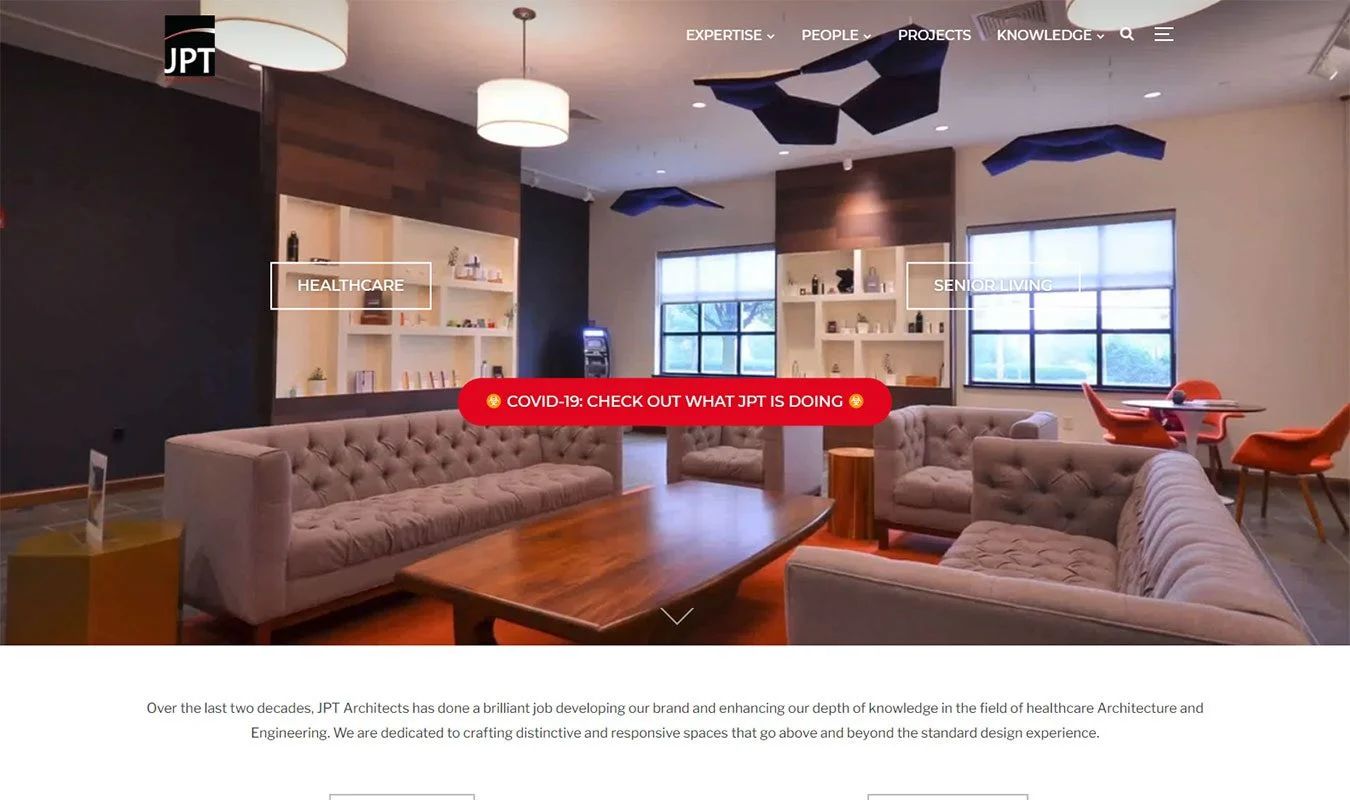
Website Redesign Transforms Healthcare Architecture Firm's Digital Presence Into Client-Focused Engagement Platform
Project Overview
JPT Architects operates at the critical intersection of healthcare delivery and built environment design: a Pennsylvania-based architectural and engineering firm dedicated exclusively to creating spaces that advance patient care, improve clinical outcomes, and support healthcare provider operations. With offices in Hollidaysburg, Johnstown, and State College, JPT brings fully integrated capabilities spanning healthcare architecture, interior design, MEP engineering, and planning to clients ranging from regional health systems to specialty medical practices.
Their specialized focus, healthcare and only healthcare, positions JPT as trusted advisors who understand the complex regulatory landscape, evolving care delivery models, infection control requirements, patient experience priorities, and operational efficiency demands that make medical facility design fundamentally different from other building types. JPT's portfolio includes hospital expansions and renovations, ambulatory surgery centers, primary care facilities, specialty clinics (cardiology, oncology, orthopedics), emergency departments, and diagnostic imaging centers: projects where design decisions directly impact patient outcomes, staff satisfaction, and organizational performance.
When JPT approached Code Conspirators, they faced challenges common to specialized professional services firms: their existing website failed to communicate their healthcare-exclusive positioning, buried their integrated architecture-engineering-interior design capabilities under generic service descriptions, lacked strategic navigation supporting different healthcare client types (hospital systems, physicians, specialty groups), and provided no clear path for converting interested healthcare organizations into project conversations.
For a firm whose work creates healing environments where communities receive care during their most vulnerable moments, their digital presence needed to reflect that same level of care, precision, and specialized expertise. The challenge wasn't just visual refresh: it required strategic positioning that differentiates healthcare-exclusive practice from general architectural firms, demonstrates deep regulatory and clinical knowledge, showcases complex project types across the care continuum, and builds trust with healthcare decision-makers who demand proven expertise before engagement.
Code Conspirators partnered with JPT Architects to engineer a WordPress website that functions as both expertise demonstration and client engagement platform, creating digital presence that positions their specialized healthcare focus while converting provider interest into project opportunities.
The Strategic Challenge
Healthcare Specialization Communication:
- "Engineering for Health" positioning requiring context and proof beyond tagline
- Healthcare-exclusive focus differentiation from general architecture firms offering healthcare as one market
- Integrated architecture-engineering-interior design value proposition unclear
- Specialized expertise (infection control, medical gas systems, imaging shielding, sterile processing) hidden
- Regulatory knowledge depth (FGI Guidelines, state health departments, accreditation standards) undemonstrated
- Clinical workflow understanding requiring evidence beyond project imagery
Multiple Healthcare Client Types:
JPT serves diverse healthcare organizations with different decision processes:
- Hospital Systems: Facilities planning, campus development, complex renovations during occupied operations
- Physician Groups: Ambulatory facilities, practice expansion, efficient clinical layouts
- Specialty Practices: Discipline-specific requirements (imaging centers, surgery centers, oncology clinics)
- Long-Term Care Facilities: Regulatory compliance, resident experience, operational efficiency
- Rural Healthcare Providers: Critical access hospitals, federally qualified health centers, unique challenges
Each client type evaluates firms differently, requiring tailored messaging addressing their specific priorities.
Care Continuum Portfolio Organization:
- Project portfolio spanning in-patient, out-patient, diagnostic, therapeutic, administrative
- Building types requiring different expertise sets and regulatory knowledge
- Visual presentation failing to communicate clinical complexity and operational considerations
- Case studies emphasizing aesthetics over patient outcomes and operational improvements
- Missing connection between project types and healthcare organization needs
- Geographic concentration requiring demonstration of Pennsylvania healthcare market knowledge
Trust Building for Healthcare Clients:
- Healthcare organizations requiring higher confidence threshold before engagement
- Proven regulatory compliance expertise essential
- Patient safety and infection control competency mandatory
- Understanding of healthcare operations and clinical workflows critical
- Evidence of occupied facility renovation expertise (most healthcare projects)
- References from similar healthcare organizations and project types
User Experience Gaps:
- Navigation failing to support healthcare organization type or project type exploration
- Portfolio requiring excessive navigation to find relevant project experience
- Service descriptions generic rather than healthcare-specific
- Contact paths insufficient for project inquiry qualification
- Mobile experience compromised for healthcare executives browsing on devices
- Content management preventing regular portfolio and thought leadership updates
Competitive Positioning Ambiguity:
- Healthcare-exclusive positioning insufficiently emphasized
- Integrated A/E/I capabilities (architecture, engineering, interior design) undersold
- Pennsylvania regional presence and healthcare market knowledge underutilized
- Sustainability and wellness expertise in healthcare context underemphasized
- Client relationships and repeat engagement rate invisible
- Professional credentials and healthcare-specific certifications buried
Code Conspirators' Strategic Solution
Healthcare-Centric Positioning Architecture:
Rather than general architecture firm presentation, we positioned JPT's specialized healthcare focus:
"Engineering for Health" Framework:
Homepage immediately establishing healthcare specialization:
- Dedicated Healthcare Expertise: "We design healing environments exclusively for healthcare providers"
- Integrated Capabilities: "Architecture, engineering, and interior design under one roof, seamless coordination for complex medical facilities"
- Regulatory Mastery: "Deep knowledge of FGI Guidelines, state health requirements, and accreditation standards"
- Patient-Centered Outcomes: "Designs that improve patient experiences, enhance clinical workflows, and optimize operational performance"
This positioning immediately differentiates JPT from generalist firms and establishes healthcare-specific credibility.
Specialized Capability Demonstration:
Service pages restructured around healthcare-specific expertise:
Before: "We provide architectural design services"
After: "Healthcare Architecture, We design patient-centered spaces that meet complex regulatory requirements while supporting evolving care delivery models"
Before: "Mechanical, electrical, and plumbing engineering"
After: "Healthcare MEP Engineering: Specialized systems for medical gas, infection control ventilation, emergency power, diagnostic imaging, and sterile processing"
Before: "Interior design services"
After: "Healthcare Interior Design, Healing environments that reduce patient stress, support family presence, and enhance caregiver satisfaction"
Each service articulation emphasizes healthcare-specific knowledge and experience.
Client-Type Navigation Strategy:
We created multiple pathways supporting different healthcare organization needs:
Healthcare Organization Landing Pages:
Hospital & Health Systems Page:
- Portfolio of hospital projects (emergency departments, operating rooms, patient towers, renovations)
- Complex challenges (occupied facility construction, phased implementation, campus master planning)
- Systems-level considerations (capacity planning, flexibility for changing care models, operational efficiency)
- Testimonials from hospital executives and facility directors
- Services relevant to hospitals (code compliance, infection control design, critical utilities coordination)
Physician Practices & Clinics Page:
- Ambulatory facility portfolio (primary care, specialty clinics, urgent care)
- Practice-specific needs (efficient patient flow, provider satisfaction, revenue optimization per square foot)
- Speed to occupancy considerations
- Testimonials from physician owners and practice administrators
- Services for outpatient facilities (efficient layouts, equipment planning, patient experience)
Specialty Care Facilities Page:
- Specialized project portfolio (ambulatory surgery, imaging centers, oncology, cardiac, orthopedic)
- Discipline-specific requirements (shielding, specialized HVAC, equipment coordination)
- Regulatory compliance for specialty centers
- Testimonials from specialty care operators
- Services for specialty facilities (advanced planning, equipment integration, patient throughput optimization)
Long-Term Care & Senior Living Page:
- Skilled nursing, assisted living, memory care portfolio
- Regulatory compliance for long-term care
- Resident experience and quality of life considerations
- Testimonials from senior care operators
- Services for long-term care (life safety, accessibility, homelike environments)
Each client-type page addresses specific evaluation criteria and concerns.
Care Continuum Portfolio Organization:
We engineered portfolio navigation reflecting healthcare decision-making:
Project Type Filtering:
- In-Patient Care: Hospital expansions, patient towers, emergency departments, surgical suites
- Out-Patient Care: Medical office buildings, clinics, ambulatory surgery centers, diagnostic centers
- Specialized Services: Imaging centers, cancer centers, cardiac facilities, orthopedic centers
- Support Services: Central sterile, pharmacy, laboratory, medical records
- Administrative & Wellness: Medical office buildings, wellness centers, campus amenities
Service Line Organization:
- Emergency Services: Emergency department design and renovation
- Surgical Services: Operating rooms, pre-op/PACU, ambulatory surgery
- Diagnostic Imaging: X-ray, CT, MRI, PET, interventional radiology
- Cancer Care: Oncology clinics, infusion centers, radiation therapy
- Primary Care: Family medicine, internal medicine, pediatrics
- Specialty Care: Cardiology, orthopedics, neurology, women's health
Project Complexity Indicators:
- Occupied facility renovations (most challenging healthcare projects)
- New construction vs. renovation vs. expansion
- Project size and budget range
- Regulatory complexity (licensure changes, certificate of need, accreditation)
Healthcare Project Case Studies:
Each portfolio piece structured to communicate healthcare-specific value:
Project Challenge Context:
- Healthcare organization goals (capacity increase, service line expansion, operational efficiency)
- Clinical workflow challenges requiring design solutions
- Regulatory and compliance requirements
- Site or building constraints
- Occupied facility coordination needs
- Budget and schedule parameters
Design Solutions:
- Architectural approach supporting clinical functions
- MEP systems addressing healthcare-specific requirements (infection control, medical gas, emergency power)
- Interior design creating healing environments
- Technology integration (nurse call, pneumatic tube, communication systems)
- Sustainability and wellness features
- Flexibility for future adaptation
Healthcare Outcomes:
- Patient experience improvements (satisfaction scores, reduced stress indicators)
- Clinical outcomes (infection rates, falls, medication errors)
- Operational performance (throughput, staff satisfaction, revenue per square foot)
- Regulatory compliance achievements
- Project delivery (on-time, on-budget, minimal operational disruption)
Client Perspective:
Testimonials from healthcare leaders emphasizing:
- Understanding of clinical operations and workflows
- Regulatory knowledge and compliance assurance
- Occupied facility coordination and communication
- Responsiveness during construction
- Post-occupancy support and issue resolution
This structure ensures prospects understand JPT's healthcare-specific expertise and proven results.
Regulatory & Clinical Knowledge Demonstration:
We transformed implied expertise into demonstrated capability:
Regulatory Competency Showcase:
- FGI Guidelines expertise (Facility Guidelines Institute standards for healthcare design)
- State health department approval process navigation
- Accreditation standards (Joint Commission, DNV, HFAP)
- Life Safety Code compliance for healthcare occupancies
- ADA accessibility in healthcare settings
- HIPAA privacy and security considerations
Clinical Understanding Evidence:
- Patient flow optimization for different care delivery models
- Caregiver visibility and efficiency considerations
- Infection control design principles (airborne isolation, protective environments)
- Medical equipment planning and coordination
- Disaster preparedness and emergency operations
- Evidence-based design research application
Blog Content Strategy:
Thought leadership demonstrating healthcare expertise:
- Evolving care delivery models (telehealth, hospital-at-home impact on facilities)
- Infection control design post-pandemic
- Outpatient migration and ambulatory facility design
- Rural healthcare facility challenges
- Aging population and healthcare facility implications
- Sustainability in healthcare (energy use intensity reduction, healthy materials)
This content attracts organic search traffic, provides conversation starters with prospects, and demonstrates forward-thinking expertise.
Visual Design Reflecting Healthcare Focus:
Professional aesthetic building trust with healthcare clients:
Clean, Clinical Aesthetic:
- Professional color palette reflecting healthcare associations (blues, greens, whites)
- High-quality photography emphasizing patient-centered spaces
- Clean layouts suggesting precision and attention to detail
- Generous whitespace creating calm, organized impressions
- Typography professional and highly readable
Patient-Centered Imagery:
- Project photography showing spaces in use (patients, families, caregivers)
- Before/after comparisons demonstrating transformations
- Detail shots of healthcare-specific elements (nurse stations, exam rooms, patient rooms)
- Technology integration visualization
- Sustainability and wellness features highlighted
Trust Signal Integration:
- Professional credentials prominently displayed (LEED, EDAC, licensed engineers)
- Healthcare-specific certifications highlighted
- Industry association involvement featured
- Awards and recognition for healthcare projects
- Client testimonials throughout rather than isolated
- Project statistics demonstrating experience breadth (total healthcare square footage, number of hospital projects, ambulatory facilities designed)
Mobile-Optimized Healthcare Executive Experience:
Healthcare decision-makers increasingly evaluate firms on mobile:
Touch-Friendly Portfolio:
- Swipeable project galleries optimized for mobile
- Simplified filtering for smaller screens
- Click-to-call direct to project leads
- Optimized forms for mobile completion
- Fast load times despite image-heavy content
Executive-Focused Mobile Content:
- Quick-access firm statistics and credentials
- Prominent testimonials from healthcare leaders
- Project outcome summaries (measurable results)
- Easy sharing of portfolio pieces with colleagues
- Streamlined contact and inquiry forms
Conversion Strategy for Healthcare Clients:
Beyond showcase, driving qualified healthcare organization inquiries:
Progressive Healthcare Engagement:
Stage 1 - Healthcare Specialization Discovery:
Visitors understand JPT's exclusive healthcare focus and integrated capabilities
Stage 2 - Relevant Project Evidence:
Portfolio exploration showing similar project types and healthcare organizations
Stage 3 - Expertise Validation:
Case studies, testimonials, and thought leadership demonstrating deep healthcare knowledge
Stage 4 - Qualified Project Inquiry:
Healthcare organizations complete detailed project information enabling strategic response
Healthcare Project Inquiry Form:
Structured to capture healthcare-specific information:
- Healthcare organization type (hospital, physician practice, specialty facility, long-term care)
- Project type (new construction, renovation, expansion, master planning)
- Service line or department (emergency, surgery, imaging, primary care, etc.)
- Project location and timeline
- Approximate size and budget
- Regulatory requirements (licensure change, CON, accreditation)
- Current project team (architect if JPT doing engineering only, or vice versa)
- How they discovered JPT
This qualification enables JPT team to respond with healthcare-specific expertise and relevant project examples.
Context-Appropriate Healthcare CTAs:
- Client-type pages: "Discuss Your Healthcare Project"
- Portfolio pages: "See Similar Healthcare Facilities" or "Request Project Details"
- Service pages: "Learn About Our Healthcare Approach"
- Case studies: "Start Your Healthcare Project Conversation"
- Blog posts: "Subscribe for Healthcare Design Insights"
WordPress Technical Implementation:
Healthcare Portfolio Management:
- Custom post types for projects with healthcare-specific metadata
- Taxonomy for care continuum, service line, project type, healthcare organization type
- Custom fields for project outcomes, healthcare statistics, regulatory achievements
- Geographic mapping showing Pennsylvania healthcare project concentration
- Related project recommendations based on healthcare organization type and project similarity
Performance Optimization:
- Medical facility photography compression and optimization
- Lazy loading for portfolio-heavy pages
- Caching for fast load times
- CDN for consistent Pennsylvania regional performance
- Mobile-specific optimizations
SEO for Healthcare:
- Healthcare-specific page optimization (emergency department design, ambulatory surgery center architecture)
- Schema markup for healthcare projects and services
- Local SEO for Pennsylvania healthcare market
- Healthcare terminology optimization
- Internal linking strategy emphasizing healthcare specialization
Content Management for Healthcare Team:
- Intuitive project addition by non-technical staff
- Healthcare-specific field templates
- Healthcare outcome tracking
- Regulatory achievement documentation
- Client testimonial management
Analytics and Healthcare Lead Tracking:
- Healthcare inquiry goal tracking
- Portfolio engagement by healthcare organization type
- Healthcare content performance metrics
- Conversion path analysis for healthcare visitors
- Healthcare-specific keyword performance
Measurable Business Impact
Healthcare-Focused Engagement:
- Increased time on site from healthcare organization visitors
- Higher healthcare portfolio exploration depth
- Improved healthcare-specific content engagement
- Reduced bounce rates on healthcare service pages
- Enhanced healthcare case study completion rates
Qualified Healthcare Inquiry Generation:
- More detailed healthcare project inquiries with regulatory context
- Increased inquiry volume from target healthcare organizations
- Higher inquiry-to-proposal conversion for healthcare projects
- Better match between inquiries and JPT healthcare capabilities
- Geographic concentration alignment with Pennsylvania healthcare market
Healthcare Brand Perception:
- Digital presence reflecting healthcare specialization and expertise
- Increased confidence sharing website with healthcare prospects
- Enhanced recruitment of healthcare-experienced professionals
- Stronger competitive positioning against generalist architecture firms
- Improved perception from hospital systems and healthcare organizations
Operational Efficiency:
- Self-service healthcare portfolio updates
- Reduced time to publish healthcare projects
- Streamlined healthcare inquiry management
- Better healthcare sales prioritization
- Scalable healthcare thought leadership publishing
Market Positioning:
- Organic search traffic growth for healthcare architecture terms
- Healthcare-specific inquiry generation from SEO
- Thought leadership positioning in Pennsylvania healthcare market
- Speaking opportunity generation at healthcare conferences
- Partnership opportunities with healthcare consultants and equipment vendors
Strategic Partnership Value
Healthcare Architecture Expertise:
Code Conspirators understood the unique requirements of healthcare-specialized architecture firms, recognizing that healthcare clients evaluate firms differently than commercial clients, that regulatory knowledge must be demonstrated rather than claimed, and that patient outcomes and operational performance matter more than aesthetics alone.
WordPress Healthcare Portfolio Excellence:
Creating healthcare-focused WordPress portfolio sites requires specialized understanding:
- Healthcare-specific taxonomy and filtering
- Care continuum organization
- Regulatory achievement tracking
- Patient outcome documentation
- Healthcare client testimonial management
We delivered infrastructure supporting JPT's healthcare portfolio evolution and thought leadership.
Multi-Stakeholder Healthcare Communication:
Healthcare projects involve administrators, clinicians, facilities directors, and boards, each with different priorities. We architected experiences supporting
- Healthcare organization type-based exploration
- Care delivery model considerations
- Regulatory compliance emphasis
- Clinical workflow optimization
- Operational performance outcomes
Trust-Building for Healthcare Services:
Healthcare organizations require exceptional confidence before engaging design professionals. We applied principles ensuring:
- Healthcare specialization immediately evident
- Regulatory knowledge demonstrated through project examples
- Clinical understanding proven through case study narratives
- Patient outcomes and operational improvements highlighted
- Healthcare client testimonials emphasizing partnership quality
Long-Term Healthcare Growth Partnership:
We established ongoing relationship supporting:
- Healthcare portfolio expansion
- Healthcare content strategy with industry trends
- Conversion optimization for healthcare visitors
- Healthcare SEO for market positioning
- WordPress maintenance and healthcare feature enhancements
Conclusion
The JPT Architects project demonstrates Code Conspirators' ability to serve healthcare-specialized professional services firms requiring digital presence matching their clinical expertise. By engineering comprehensive WordPress website combining healthcare-exclusive positioning, care continuum portfolio organization, regulatory knowledge demonstration, and healthcare client conversion optimization, we helped JPT transform their website from generic portfolio to healthcare expertise platform.
This wasn't just web design: it was strategic healthcare positioning enabling JPT's architecture, engineering, and interior design capabilities to compete effectively in markets where healthcare specialization, regulatory mastery, and proven clinical outcomes separate selected firms from eliminated candidates. The website transforms healthcare expertise into accessible evidence, scaling JPT's reach through digital presence reflecting their healthcare leadership.
For JPT Architects, the new website represented enhanced healthcare inquiry generation, improved healthcare brand perception, and foundation for continued growth serving Pennsylvania healthcare providers. For healthcare organizations, it provided confidence-building evidence of specialized expertise, clear understanding of integrated A/E/I value, and straightforward paths to healthcare project conversations. And for Code Conspirators, it exemplified our capability to engineer websites for specialized professional services that balance technical expertise with conversion effectiveness, delivering healthcare credibility, user experience sophistication, and measurable business results.
As JPT Architects (now part of CPL) continues engineering healing environments across Pennsylvania, their website continues connecting healthcare providers with specialized expertise, enabling qualified healthcare organizations to engage with clarity about JPT's capabilities and confidence in their ability to deliver patient-centered, operationally excellent, regulatory-compliant healthcare facilities.
Key Takeaway: Healthcare-specialized architecture firms need websites demonstrating deep clinical knowledge while driving healthcare organization inquiries. Code Conspirators builds WordPress sites showcasing healthcare expertise, supporting care continuum navigation, and converting healthcare provider interest into qualified project conversations through strategic healthcare positioning.