
You're Optimizing for the Wrong Keywords. Here's What Your Prospects Actually Search.
Match content to real search intent so high-value prospects find your firm through the phrases and questions they actually use.
You're Optimizing for the Wrong Keywords. Here's What Your Prospects Actually Search.
You spent six months ranking for "personal injury attorney."
You celebrated when you hit page 1. You told your partners. Maybe you called the SEO agency and said "good job."
Meanwhile, your ideal prospect just searched "car accident lawyer near me that doesn't charge upfront." Your competitor showed up. You didn't. They got the call. You got nothing.
Same intent. Different search. Different winners.
Last week, we showed you how competitors are finding your prospects first. This week, we're showing you why the keywords you're proud of ranking for might be the ones bringing you the least qualified traffic. And how the gap between what you optimize for and what your prospects actually type is where your best leads are hiding.
This is Week 3 of our 12-week CAPTURE series. This week bridges TARGET and ATTRACT. We're moving from competitive intelligence into organic visibility, starting with the most fundamental question: are you optimizing for how your prospects actually search?
The Intent Mismatch
Here's a secret that costs practices millions.
Most practices optimize for industry terminology. "Personal injury attorney." "Estate planning lawyer." "Cosmetic surgery." "Financial advisory services."
Prospects don't search in industry terminology. They search in plain language. They search how they talk.
Nobody says "I need to retain a personal injury attorney." They say "I got hit by a truck and need a lawyer who won't charge me unless I win."
Nobody types "elective cosmetic surgical procedures" into Google. They type "how much does a nose job cost in [city]."
Nobody searches for "comprehensive financial advisory services for high-net-worth individuals." They search "best financial advisor near me for someone with $500k to invest."
The gap between what you optimize for and what your prospects actually type is massive. And that gap is where your best leads are hiding. You can read more about why Google can't find most professional service websites, but the core issue is simpler than you think. You're speaking one language. Your prospects are searching for another.
We see this every time we audit a practice's website. Their service pages are titled "Personal Injury Representation" and "Estate Planning Services." Their prospects are searching "what to do after a car accident that wasn't my fault" and "how to set up a trust for my grandchildren."
👉 Same services. Completely different language. Zero connection between the two.
You can see how this connects to the 8th-grade reading test your website probably failed. If your website reads like a legal brief or a medical journal, you're not just losing readability. You're losing search visibility. Google and AI tools match content to how people search. If your content doesn't use the language your prospects use, you don't show up.
Search Intent Categories Explained
Not all searches are equal. Understanding the difference is the foundation of intent-based SEO.
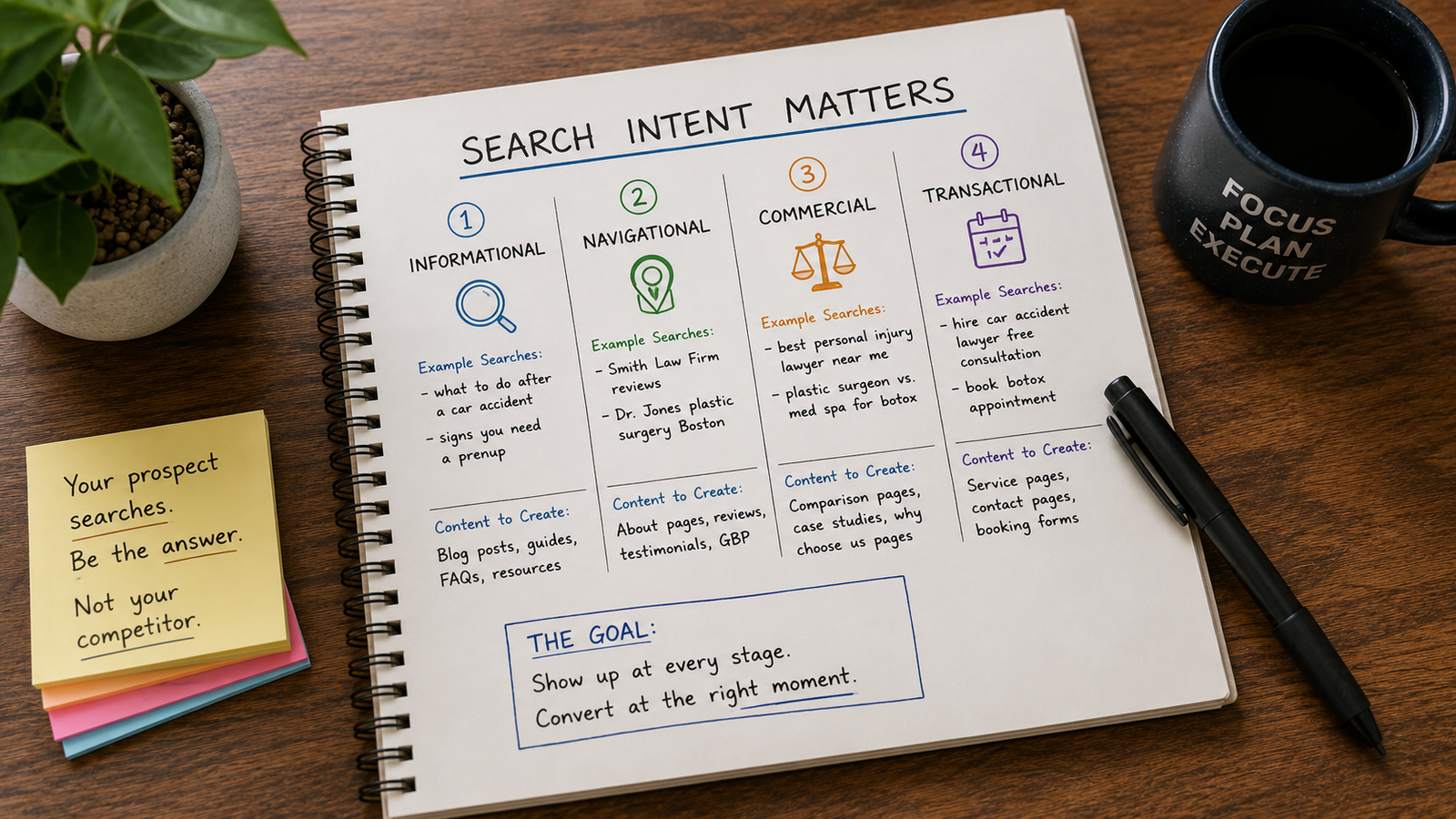
There are four types of search intent. Each one represents a different stage of your prospect's journey. Each one needs different content.
1. Informational Intent. The prospect is researching. They have a problem and want to understand it better. They search "what to do after a car accident" or "signs you need a prenup" or "difference between a will and a trust." These searches have high volume but low conversion. The prospect isn't ready to hire. They're gathering information.
Content for this stage: blog posts, FAQ pages, educational guides. The goal isn't conversion. It's visibility and trust. You want to be the firm that answers their question so when they're ready to act, they remember you.
2. Navigational Intent. The prospect knows who they're looking for. They search "Smith Law Firm reviews" or "Dr. Jones plastic surgery Boston." They're past the research phase. They've heard of you or found you and want to learn more. These searches are lower volume but high intent.
Content for this stage: a strong "About" page, review pages, testimonial pages, Google Business Profile. Make it easy for them to confirm they're making the right choice.
3. Commercial Intent. The prospect is comparing options. They search "best personal injury lawyer near me" or "top-rated estate planning attorneys in [city]" or "plastic surgeon vs. med spa for botox." They're ready to act but haven't chosen who. This is where you win or lose against competitors.
Content for this stage: comparison pages, "Why Choose Us" pages, case studies, comparison guides, review showcases. Your goal is to out-position competitors at the exact moment of comparison.
4. Transactional Intent. The prospect is ready to act. They search for "hire car accident lawyer free consultation" or "schedule consultation with estate planning attorney" or "book botox appointment [city]." They've decided. They just need to find someone to call.
Content for this stage: service pages with clear CTAs, booking pages, consultation request forms. Make it frictionless. One click to act.
Most practices have content for informational intent (blog posts) and transactional intent (service pages). They miss commercial intent entirely. That's the stage where prospects are comparing you to competitors. If you don't have content for that stage, you lose to competitors who do.
The Long-Tail Advantage
Here's where most practices make their biggest keyword mistake.
"Personal injury attorney" gets 40,000 monthly searches. The competition is brutal. You're competing against Avvo, FindLaw, Justia, and every law firm in your city with an SEO budget. Your 800-word service page will never outrank them.
"Car accident lawyer who works on contingency" gets 300 monthly searches. The competition is almost nonexistent. No major directory targets that phrase. Most local firms don't even know it exists. And the 300 people searching it are not researchers. They're ready to hire. They convert at 4x the rate of someone searching "personal injury attorney."
This is the long-tail advantage. Longer, more specific search phrases that have lower volume but dramatically higher intent. You can read more about how prospects use AI search tools to understand why this matters even more now. AI tools like ChatGPT and Perplexity don't just match keywords. They interpret intent. Content that matches natural language intent gets recommended by AI. Content that reads like keyword stuffing gets ignored.
We worked with an auto shop client who doubled their leads in month one by targeting intent-based long-tail searches competitors ignored. The same principle applies to professional services. The long-tail is where qualified prospects live, and it's where your competitors aren't competing.
Here's the math that makes this work:
👉 Broad term: 40,000 searches, position 7, 1.2% CTR = 480 visitors. Conversion rate at 2% = 9.6 leads.
👉 Long-tail term: 300 searches, position 1, 28.4% CTR = 85 visitors. Conversion rate at 8% = 6.8 leads.
Fewer visitors. More leads. Because every visitor had high intent.
Now multiply that across 20 long-tail keywords. 20 keywords x 6.8 leads = 136 qualified leads from less traffic than one broad keyword. That's the power of intent-based targeting.
How to Map Your Prospects' Actual Search Language
You don't need expensive tools to figure this out. You need to listen.
Source 1: Your intake staff. Your intake staff hears exactly how prospects describe their problems. Every first call is a search query spoken out loud. Ask your intake staff: "What are the top 3 questions new clients ask during their first call?" Those questions are your keyword research.
A prospect who calls and asks "how much does a consultation cost?" is telling you they searched "free consultation lawyer near me" before they called. A prospect who asks "do you handle cases where the other driver was uninsured?" is telling you they searched for "uninsured driver accident lawyer."
Source 2: Call recordings. If you record intake calls (and you should), listen to the first 60 seconds of your last 20 calls. Write down the exact phrases prospects use to describe their situation. Those phrases are your content topics. Every one of them is a search query you should be targeting.
Source 3: Google Search Console. Go to Search Console and look at the queries bringing traffic to your site. Filter for queries that include question words (how, what, when, should, can). Those are informational searches. Now filter for queries that include action words (hire, cost, consultation, near me, best, reviews). Those are commercial and transactional searches.
The gap between what you rank for and what your prospects actually search is your content roadmap.
Source 4: AnswerThePublic or Google's "People Also Ask." Type your primary service into Google. Scroll to the "People Also Ask" section. Those questions are what real people search for. Each one is a content topic. Each one is a long-tail keyword with clear intent.
Building Content Around Intent, Not Keywords
Once you know how your prospects search, you need content that matches each intent stage.
Here's a simple framework.
For each of your core services, build:
One pillar page. This is your main service page. It targets the broad commercial term ("personal injury attorney [city]"). It's comprehensive. It covers what you do, who you help, and why you're different. This page has your primary CTA: schedule a consultation.
Five to seven supporting articles. Each one targets a specific long-tail question. "What to do after a car accident that wasn't your fault." "How long do you have to file a personal injury claim in [state]." "What if the other driver was uninsured." Each article answers the question thoroughly, then links to the pillar page with a CTA to schedule a consultation.
One comparison page. "How to choose the right personal injury lawyer for your case." This targets commercial intent. It helps prospects who are comparing options understand what to look for. It positions you as the expert guide, not just another option.
One FAQ section. Answer the top 10 questions your intake staff hears. Use the exact language prospects use. This captures informational intent and feeds AI search engines the structured Q&A content they love to cite.
This structure works because it mirrors how your prospects actually search. They start with questions (informational). They move to comparison (commercial). They end with action (transactional). Your content meets them at each stage and guides them to the next.
Each piece of content links to the next. The pillar page links to supporting articles. Supporting articles link back to the pillar page and to the comparison page. The comparison page links to the CTA. It's a connected system, not a pile of disconnected blog posts.
You can see how this fits into the full CAPTURE framework on our CAPTURE hub page. Content strategy is one piece of ATTRACT. It works alongside local SEO, reviews, and AI search visibility to build a system that compounds.
The CAPTURE Score Mini-Assessment
How well do you match search intent?
1. Do you have separate service pages for each distinct service you offer? Yes = 1 point. No = 0 points.
2. Does your site include an FAQ section answering questions in your prospects' natural language? Yes = 1 point. No = 0 points.
3. Have you reviewed call recordings or intake notes for the exact phrases prospects use to describe their problem? Yes = 1 point. No = 0 points.
4. Do you track which search queries lead to consultations vs. which lead to bounces? Yes = 1 point. No = 0 points.
Score 0-1: Intent mismatch costing you leads. Your content speaks industry jargon. Your prospects search in plain English. The gap is sending them to competitors.
Score 2: Partial coverage with gaps. You have some intent-based content but missing commercial or transactional stages.
Score 3-4: Strong intent alignment. You're meeting prospects at each stage of their search journey.
CAPTURE Myths
Myth: "I need to rank for the highest-traffic keywords."
Truth: You need to rank for the highest-intent keywords. "Estate planning attorney" gets 22,000 searches. "How to set up a trust for my grandchildren" gets 890 searches. But the 890 people searching the long-tail phrase are ready to act. The 22,000 searching the broad term include students, researchers, competitors, and people in other states. Quality beats quantity. Every. Single. Time.
This Week's Action Item
This takes 10 minutes. Do it today.
Ask your intake staff (or answer yourself if you handle intake): "What are the top 3 questions new clients ask during their first call?"
Write those three questions down.
Now open your website. Can you find a page that answers each question clearly, in the language the prospect used to ask it?
If you can't, you have an intent gap. Every day that gap exists, prospects search those exact questions, don't find the answer on your site, and find a competitor who does answer it.
That's not a guess. That's what's happening right now.
What's Coming Next
Next week, we're entering ATTRACT territory. We'll show you how AI is already recommending your competitors to prospects who should be finding you. ChatGPT, Perplexity, Google AI Overviews. They're all making recommendations based on your digital footprint. If that footprint is thin, AI fills the gaps with assumptions that don't favor you.
Week 4 will change how you think about search visibility. It's not just about Google anymore.
We'll also be going deeper on all of this in our live workshop, "CAPTURE: Fill Your Pipeline With Qualified Prospects" on November 4. We'll share registration details as we get closer.
Your Next Step
You can keep optimizing for keywords that sound impressive but bring you researchers instead of clients. Or you can find out which high-intent searches you're missing and start capturing them.
👉 Run the Full C4 Diagnostic and see where your content gaps are hiding. It takes under 3 minutes. No cost. No obligation.
🔎 Download The Capture Blueprint for the keyword strategy checklist and intent-based content template.
See exactly how you rank against the firm showing up above you.
The Rankings Diagnostic compares your search visibility to your closest competitor: by keyword, by location, by practice area. You'll see the gap, what's causing it, and what closing it is worth in new clients. Free. Under 3 minutes.