
Your Blog Has 200 Posts and Generated Zero Leads. Here's What to Write Instead.
Turn dead blog traffic into leads with answer-engine content built around prospect intent, AI recommendations, and topics that drive action.
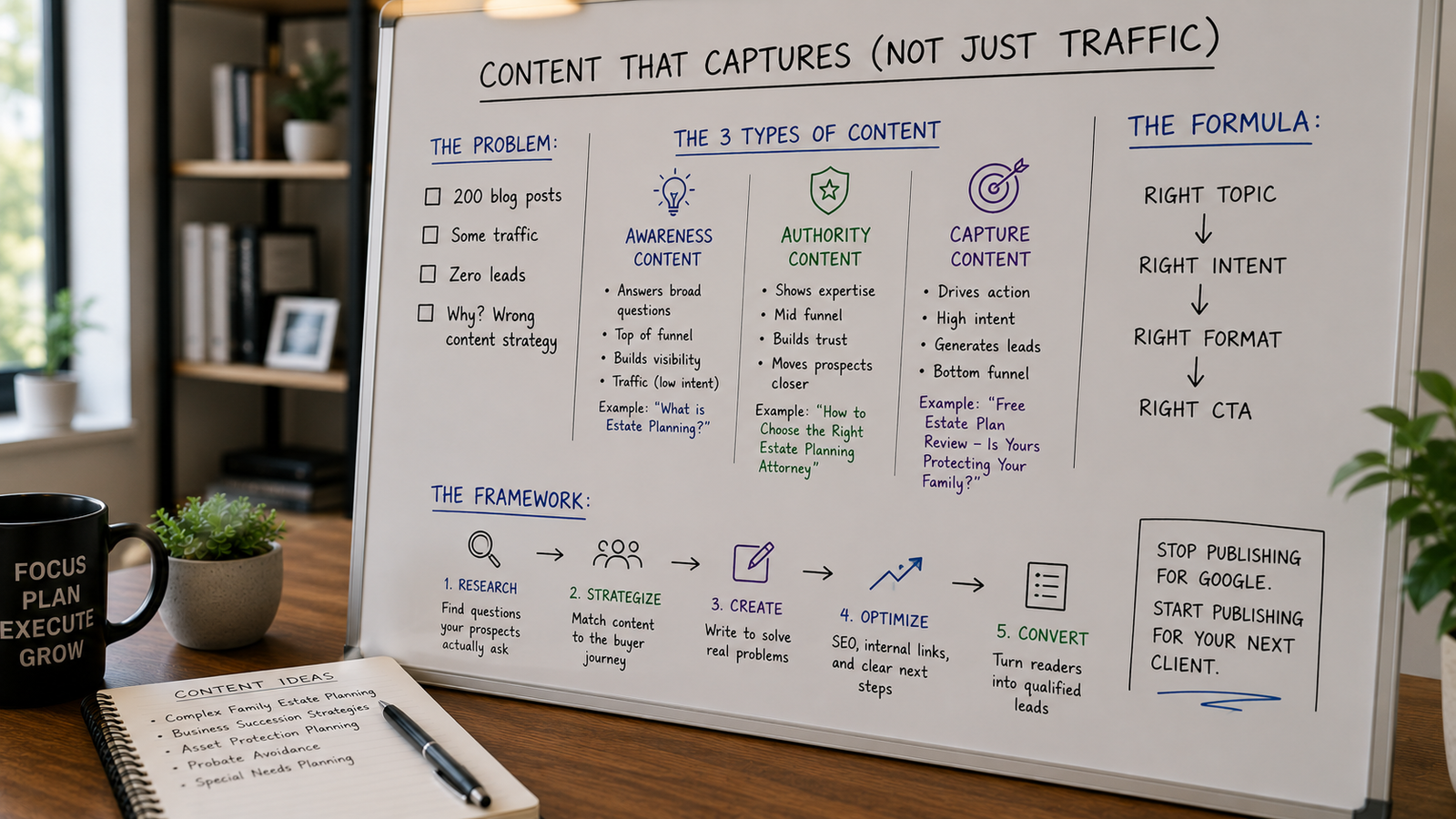
Your Blog Has 200 Posts and Generated Zero Leads. Here's What to Write Instead.
You started blogging two years ago.
Your marketing advisor told you content was king. "Just keep publishing," they said. "Google rewards consistent content."
So you published. Every week. Sometimes twice. You wrote about legal updates. Industry news. Generic tips. "5 Things to Know About Estate Planning." "How to Choose a Financial Advisor." "What to Expect During Your First Consultation."
Two hundred posts later, your analytics dashboard shows traffic. Some posts get 50 visits a month. A few get 200. One got 1,400.
Your CRM shows zero leads from any of them.
Zero. Two hundred posts. Zero leads.
Last week, we showed you why the Google Map Pack matters more than page 1. This week, we're showing you why most professional service blogs are dead weight, and what to write instead. Content that captures. Content that converts. Content that compounds.
This is Week 6 of our 12-week CAPTURE series. We're still in ATTRACT, and this week is all about content strategy. Not the kind your last agency sold you. The kind that actually fills your pipeline.
The Content Trap: Why Most Professional Service Blogs Are Dead Weight
Here's what happened.
You published 200 posts because someone told you quantity matters. But you published the wrong content. Content that attracts researchers. Content that answers questions without creating action. Content that lives on your site, gets read, and disappears into the void.
Let's be specific about why this fails.
👉 Your content answers questions but doesn't create urgency. "What is estate planning?" educates. It doesn't motivate me. The reader finishes the article, thinks "good to know," closes the tab, and moves on. No CTA. No next step. No reason to contact you. You gave them a free education and asked for nothing in return.
👉 Your content targets broad topics with high competition and low intent. "5 Things to Know About Estate Planning" competes with Forbes, Nolo, LegalZoom, and every law firm in America writing the same article. You will never outrank them. And even if you did, the person reading that article isn't ready to hire. They're at the beginning of their research. You're capturing attention, not intent.
👉 Your content isn't connected to your service pages. Your blog posts exist in isolation. They don't link to your service pages. They don't drive readers toward a consultation. They don't move prospects through a journey. They're standalone islands of information that generate traffic but never convert.
👉 Your content dilutes your authority signal. Here's the counterintuitive part. Publishing 200 thin, generic posts actually hurts your SEO. Google and AI search engines assess content quality, not just quantity. 200 shallow posts tell Google your site is a content farm. 20 deep, authoritative, intent-targeted posts tell Google you're an expert.
You can read more about why Google can't find most professional service websites to understand how content quality affects visibility. But the bottom line: more content isn't better. Better content is better. And "better" means content designed to capture leads, not just attention.
The Three Types of Content (And Which One Actually Captures Leads)
Not all content serves the same purpose. Understanding the difference is what separates practices that generate leads from content from practices that generate traffic from content.
Type 1: Awareness Content.
This is content that answers broad, informational questions. "What is a trust?" "How does personal injury law work?" "When should I start planning for retirement?"
Purpose: visibility. You want to show up when prospects research their problem. This content gets traffic but rarely converts directly. It's top-of-funnel. It introduces you to prospects who don't know they need you yet.
This content has a role. But it's not your lead generator. It's your brand builder. Use it sparingly. One or two posts per topic. Make them deep and authoritative. Don't write five variations of "what is estate planning."
Type 2: Authority Content.
This is content that demonstrates expertise on specific, high-intent topics. "How to choose the right estate planning attorney for complex family situations." "What to do if the insurance company denies your car accident claim." "How to evaluate a financial advisor's fiduciary commitment."
Purpose: trust. This content targets prospects who know they have a problem and are evaluating solutions. It positions you as the expert guide. It's mid-funnel. It moves prospects from "I have a problem" to "this firm understands my problem."
This content converts. Not always immediately. But it builds the relationship that leads to a call. This is where most of your content effort should go.
Type 3: Capture Content.
This is content designed specifically to generate a lead. It's actionable, urgent, and connected to a clear CTA. "Free case evaluation: Is your personal injury claim worth pursuing?" "Take the 60-second estate planning readiness assessment." "Download the complete guide to protecting your assets before retirement."
Purpose: conversion. This content asks for something. A form fill. A call. A download. It's bottom-of-funnel. It captures prospects who are ready to act or close to it.
This is the content most practices never create. They write awareness content and wonder why nobody calls. Capture content is different. It doesn't just inform. It invites action.
The winning formula is a mix of all three. But the ratio matters. Most practices publish 90% awareness content, 10% authority content, and 0% capture content. That's why their blogs generate zero leads.
The ratio that works: 20% awareness, 50% authority, 30% capture.
The "Answer Engine" Content Framework
Here's where content strategy meets AI search.
In Week 4, we showed you how AI is already recommending your competitors. AI search engines recommend content that directly answers questions in a structured, authoritative way. Generic blog posts don't get recommended. Answer engine content does.
The Answer Engine Content Framework has four elements. Every piece of content you publish should include all four.
Element 1: The Direct Answer.
Start with the answer. Not a story. Not a setup. The answer. When someone asks "how long do I have to file a personal injury claim in Pennsylvania," the first sentence of your content should be "In Pennsylvania, you have two years from the date of the accident to file a personal injury claim."
AI search engines pull the first clear, direct answer they find. If your content buries the answer in paragraph 3, AI skips it. Direct answers get cited. Direct answers get recommended.
Element 2: The Context.
After the direct answer, provide context. Why does this matter? What are the exceptions? What should the prospect consider? This is where you demonstrate expertise. But it comes after the answer, not before.
Element 3: The Action.
Every piece of content ends with a specific action the prospect should take. Not "contact us for more information." That's vague. Specific: "If your accident happened more than 18 months ago, you're running out of time. Schedule a free case evaluation today to find out if you can still file."
The action creates urgency. It connects the content to your services. It moves the prospect from reader to lead.
Element 4: The Structure.
AI search engines love structure. Use clear headings. Use Q&A format where appropriate. Use bullet points and numbered lists. Use schema markup to tell AI exactly what your content answers.
Structured content gets recommended by AI. Unstructured content gets ignored. It's that simple.
How to Structure a Single Piece of Content to Capture Leads
Here's a template you can use for every piece of captured content you create. This structure works for blog posts, landing pages, and resource guides.
Section 1: The Hook (First 2 sentences)
Start with the prospect's situation. Not your firm. Not your services. Their situation. "If you've been in a car accident and the insurance company is dragging their feet, you're probably wondering whether it's worth hiring a lawyer."
This creates immediate recognition. The prospect thinks "that's me." They keep reading.
Section 2: The Direct Answer (Next 1-2 paragraphs)
Answer the question directly. No preamble. No throat-clearing. "Yes, it's almost always worth hiring a lawyer for a car accident claim. Studies show accident victims with attorneys receive settlements 3.5x larger than those without."
Section 3: The Context (Next 3-5 paragraphs)
Explain why. Give specifics. Use real examples. "Insurance companies have teams of adjusters trained to minimize payouts. When you don't have representation, they know you're unlikely to take your case to court. They offer low settlements because they can."
Use data. Use case examples (anonymized). Use plain language. This is where you build trust and authority.
Section 4: The Common Mistakes (3-5 bullet points)
Show prospects what they're probably doing wrong. This creates self-identification. "Most accident victims make these mistakes: accepting the first offer, giving recorded statements without a lawyer, waiting too long to seek medical treatment, posting about the accident on social media."
Each mistake is a pain point. Each pain point reinforces the need for your help.
Section 5: The CTA (Final section)
Tell them exactly what to do next. Make it specific, urgent, and frictionless. "Don't let the insurance company decide what your claim is worth. Get a free case evaluation today. It takes 10 minutes. You'll know exactly where you stand and what your options are. Call [phone number] or fill out the form below."
Every piece of content you publish should follow this structure. Hook, answer, context, mistakes, CTA. It's not complicated. But it requires discipline. Most practices skip the CTA. That's why their content generates traffic but never leads.
The Content Compounding Effect
Here's the good news about content done right. It compounds.
When you publish 20 deep, authoritative, intent-targeted articles, each one does three things.
First, it ranks. Because it targets high-intent long-tail keywords with low competition. (We covered this in Week 3.)
Second, it builds topical authority. Google and AI see that you've written extensively about a specific topic. They start treating you as an expert on that topic. Your rankings improve across all related searches.
Third, it feeds your AI visibility. Structured, direct-answer content is exactly what ChatGPT, Perplexity, and Google AI Overviews look for when making recommendations. Each piece of answer engine content increases your chances of being recommended.
This creates a compounding effect. More content leads to more authority. More authority leads to better rankings. Better rankings lead to more visibility. More visibility leads to more leads. More leads lead to more data about what works. More data leads to better content. The flywheel spins faster over time.
But the flywheel only works if the content is right. 200 generic posts create no momentum. 20 targeted posts create a system that feeds itself.
👉 The firms that win at content aren't the ones publishing the most. They're the ones publishing with purpose.
You can see how content strategy fits into the complete CAPTURE system on our CAPTURE hub page. Content is the engine of ATTRACT. It drives organic search visibility, AI recommendations, and lead capture all at once.
The CAPTURE Score Mini-Assessment
How well does your content capture leads?
1. Does every blog post on your site include a specific CTA tied to a service or consultation? Yes = 1 point. No = 0 points.
2. Can you identify which blog posts have generated leads vs. which have only generated traffic? Yes = 1 point. No = 0 points.
3. Do your blog posts follow a structure that includes a direct answer, context, common mistakes, and a CTA? Yes = 1 point. No = 0 points.
4. Have you pruned or consolidated thin, low-quality content from your site in the last 12 months? Yes = 1 point. No = 0 points.
Score 0: Your blog is a content graveyard. Traffic with no leads. You're attracting researchers, not clients.
Score 1-2: Partial structure. Some posts convert, most don't. You need a content audit and a restructuring plan.
Score 3-4: Your content is strategic. You're capturing leads from your blog. The question is whether you're scaling the approach across all topics.
CAPTURE Myths
Myth: "I need to publish every week to keep Google happy."
Truth: Google rewards quality and relevance, not publishing frequency. Publishing one exceptional, intent-targeted article per month will outperform four generic posts per week. Every time. Stop measuring content success by volume. Start measuring by leads generated per piece. That's the only metric that matters.
This Week's Action Item
This takes 30 minutes. Do it this week.
Open your blog. List your top 10 posts by traffic. For each one, answer these questions:
- Does this post target a high-intent search or a broad informational search?
- Does this post include a specific, action-oriented CTA?
- Has this post generated any leads? (Check your CRM or call tracking.)
- Is this post connected to a service page on your site?
If most of your top posts are informational with no CTA and no leads, you've found the problem. Your content attracts readers but never asks them to act.
Pick one post. Rewrite it using the structure above. Hook, direct answer, context, common mistakes, CTA. Republish it. Track the results for 30 days.
If leads increase from that single post, you've proven the framework works. Now apply it to the rest.
What's Coming Next
Next week, we're tackling the quitting point. The moment when most practices give up on SEO because they don't see results yet. We'll show you the compounding curve of SEO, why results accelerate suddenly after a period of apparent stagnation, and how to know whether you're 30 days from a breakthrough or wasting your time.
Week 7 will save you from the most expensive mistake in digital marketing: quitting right before it works.
We'll also be going deeper on all of this in our live workshop, "CAPTURE: Fill Your Pipeline With Qualified Prospects" on November 4. We'll share registration details as we get closer. We'll review live content audits during the session so you can see exactly which posts are generating leads and which are dead weight.
Your Next Step
You can keep publishing content that generates traffic but never leads. Or you can find out which content gaps are costing you and start writing content that captures.
👉 Run the Content Diagnostic and see which of your blog posts generate leads and which are dead weight. Not a guess. Data.
🔎 Download The Capture Blueprint for the answer engine content template, the content audit checklist, and the lead-tracking framework.
Your prospects are reading content right now. The question is whether your content educates them and sends them to a competitor, or educates them and brings them to you.
Find out what's stopping visitors from calling you.
Right now, someone is on your website comparing you to two other firms. The Conversion Diagnostic scores how well your site turns that visit into a booked consultation, and shows you exactly what's creating the friction. Free. Takes 2 minutes.