
The Review Generation System That Took a Law Firm From 23 to 387 Reviews in 11 Months.
Build a review generation system that improves map pack visibility, strengthens AI recommendations, and grows reviews with smart timing and automation.
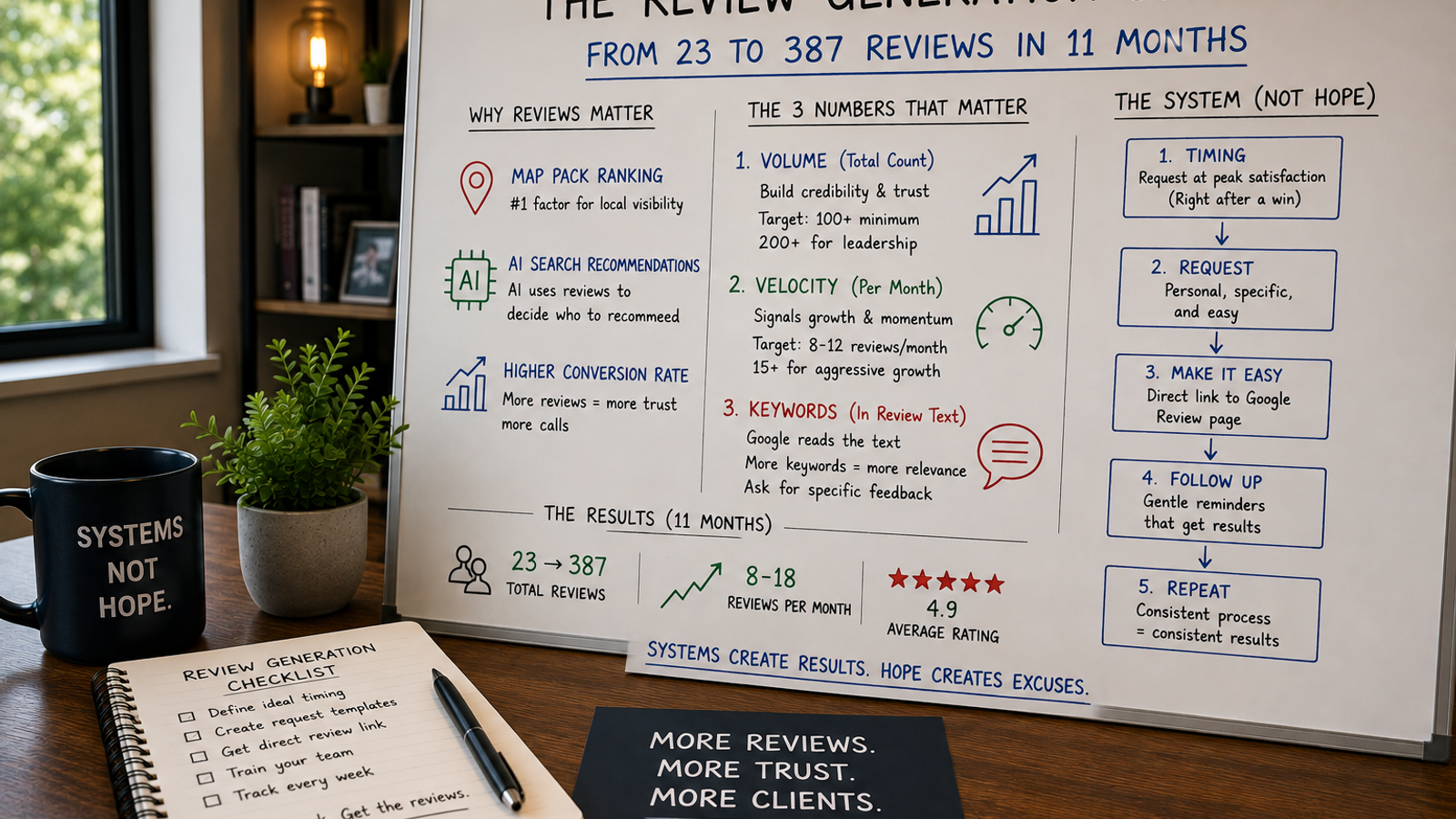
The Review Generation System That Took a Law Firm From 23 to 387 Reviews in 11 Months.
Your competitor has 312 reviews on Google.
You are 23.
They're in the map pack. You're not. AI search recommends them. It doesn't mention you. Prospects who compare you side by side see 312 reviews next to your 23 and make a judgment before they ever read a word of your website.
You know reviews matter. You ask clients for reviews sometimes. When you remember. When the intake staff reminds you. When a client says something nice. But you don't have a system. You have good intentions. Good intentions don't generate reviews. Systems do.
Last week, we showed you why quitting SEO at month 6 costs you millions. This week, we're showing you the one ranking factor that accelerates SEO, map pack positioning, and AI search recommendations all at once. Reviews. Not just getting more of them. Getting them consistently, with the right keywords, at the right velocity, on autopilot.
This is Week 8 of our 12-week CAPTURE series. We're at the intersection of ATTRACT and COMPETE. Reviews drive organic visibility. They also drive competitive authority. One system. Two massive benefits.
Why Reviews Control Everything (Map Pack, AI Search, Conversion Rate)
Reviews are not a vanity metric. They are the single most powerful signal across every platform that determines whether prospects find you and choose you.
Here's what reviews control.
Map pack ranking. In Week 5, we showed you that review volume and velocity are the #1 ranking factor for the Google Map Pack. Google treats reviews as crowd-sourced credibility. More recent reviews signal an active, thriving practice. Stale reviews signal decline.
AI search recommendations. In Week 4, we showed you that AI pulls review signals to determine who to recommend. ChatGPT, Perplexity, and Google AI Overviews all treat review volume and sentiment as proof of authority. If your review profile is thin, AI either skips you or hedges with weak language.
Conversion rate on your website. This one surprises people. Reviews don't just help prospects find you. They help prospects choose you. A practice with 312 reviews and a 4.8 rating converts website visitors at 2 to 3x the rate of a practice with 23 reviews and a 4.6 rating. The math is brutal and simple. More reviews. More trust. More calls.
👉 93% of consumers read reviews before choosing a service provider. 👉 Practices with 50+ reviews get 3x more clicks than those with under 10. 👉 Practices with 200+ reviews get 6x more clicks than those with under 50.
Reviews are not one factor among many. They are the factor that multiplies all other factors. Good SEO with no reviews still loses. Good reviews with no SEO still converts. Good SEO with strong reviews dominates.
The Three Numbers That Matter (Volume, Velocity, and Keywords)
Most practices track one number: total review count. That's like tracking total revenue without tracking profit margin. It tells you something, but not the thing that matters most.
Three numbers determine your review power. Track all three.
Number 1: Volume (Total Count)
This is your credibility baseline. The number prospects see before they read a single review. It's the number Google uses to compare you to competitors. It's the number AI uses to decide whether to recommend you.
Target: 100+ minimum for professional service practices. 200+ for market leadership. 300+ for dominance.
A practice with 23 reviews looks like a practice that either opened recently or doesn't have many satisfied clients. A practice with 312 reviews looks like a practice that has been serving clients well for years. Fair or not, that's the perception.
Number 2: Velocity (Reviews Per Month)
This is the growth metric. How fast you're acquiring new reviews. We covered this in Week 5, but here's the deeper breakdown.
Velocity matters more than volume for two reasons.
First, Google's map pack algorithm weights recent reviews heavily. A firm with 300 reviews but only 2 in the last 90 days signals decline. A firm with 80 reviews but 14 in the last 90 days signals momentum. Momentum ranks higher.
Second, velocity tells Google your practice is active and growing. Stale review profiles suggest a practice that might be closed, declining, or irrelevant.
Target: 8 to 12 new reviews per month minimum. 15+ for aggressive growth.
If your top competitor is getting 18 reviews per month and you're getting 2, they're gaining ground on you every single day. Not because they're better. Because they have a system and you don't.
Number 3: Keywords (Service-Specific Terms in Review Text)
This is the number nobody tracks. And it might be the most powerful of the three.
Google reads the text of your reviews. When reviews mention your services by name, those keywords strengthen your ranking for those services.
A review that says "Smith Law Firm did a great job" helps your overall rating. A review that says "Smith Law Firm handled my car accident case and got me a settlement 3x what the insurance company offered" helps your ranking for "car accident lawyer," "car accident case," and "insurance settlement."
Google treats review text as user-generated content about your business. Keywords in review text carry weight because they come from clients, not from you. It's the most credible keyword signal Google can find.
Target: At least 40% of your reviews should mention a specific service or outcome. "Estate planning." "Botox treatment." "Divorce representation." "Financial plan." The exact words prospects search for.
The Review Generation System (Step by Step)
Here's the system that took a law firm from 23 reviews to 387 in 11 months. No incentives. No contests. No awkward conversations. Just a system that runs automatically.
Step 1: Identify the Right Moment
The biggest mistake practices make is asking for reviews at the wrong time. They ask after the case closes, after the treatment is complete, after the engagement ends. By then, the client has moved on emotionally. The excitement of a positive outcome has faded. They intend to leave a review. They just don't.
The right moment is the moment of peak satisfaction. For a law firm, that's when the client receives their settlement check. For a medical practice, that's when the patient sees their results for the first time. For a financial advisor, that's when the client's portfolio outperforms expectations.
Identify the moment in your client journey when satisfaction peaks. That's your review trigger point.
Step 2: Automate the Ask
Manual review requests fail because humans forget. The intake staff forgets. The partner forgets. The client forgets. Everyone has good intentions. Nobody follows through.
Automation solves this. Here's how.
Set up an automated trigger in your CRM that fires at the peak satisfaction moment. For a law firm, the trigger fires when the case status changes to "settled." For a medical practice, the trigger fires 7 days post-procedure. For a financial advisor, the trigger fires after the quarterly review meeting.
The automation sends a personalized email from the partner or principal (not from a generic "info@" address). The email is short. It acknowledges the outcome. It asks for a review. It includes a direct link to your Google Business Profile review page. One click. No searching.
Here's the email template that works:
"Hi [Client Name],
I'm glad we could [achieve specific outcome, e.g., "secure your settlement" or "complete your procedure successfully"].
Your experience can help others who are in the same situation you were. Would you take 60 seconds to share a quick review? It helps people who are looking for [your service] find someone they can trust.
Here's the link: [Google Review Link]
Thank you for trusting us with your [case/treatment/portfolio]. It means a lot.
[Partner Name]"
Short. Personal. Specific. One action. One click.
Step 3: Follow Up Once (Automated)
Not everyone reviews on the first ask. They intend to. They get distracted. Life happens.
Set an automated follow-up email to send 3 days after the first request if no review is posted. One follow-up. Not five. One.
The follow-up should be even shorter:
"Hi [Client Name],
I sent you a note last week about leaving a quick review. I know you're busy, so I'll keep this short. If you have 60 seconds, here's the link: [Google Review Link]
It genuinely helps other people who are looking for [your service] make a confident decision.
Thanks again, [Partner Name]"
That's it. Two emails. Automated. Zero manual effort after setup.
Step 4: Track and Categorize
Set up a simple tracking system. A spreadsheet works. Track:
- Date of request
- Date of review (if posted)
- Review platform (Google, Yelp, Avvo, Healthgrades)
- Service mentioned in review (if any)
- Rating
- Response status (did you reply?)
This tracking tells you:
- Your actual review velocity (requests vs. postings)
- Which services get mentioned most (valuable keyword data)
- Your conversion rate from ask to review (aim for 30%+)
- Which platforms need attention
Review the tracker monthly. Patterns will emerge. You'll see which case types generate the most reviews. Which timing produces the highest response rate. Which email subject lines work best.
Step 5: Respond to Every Review
This is the step most practices skip. And it's the step that multiplies the value of every review.
Respond to every review. Positive and negative. Within 24 hours.
For positive reviews, your response should:
- Thank the reviewer by name
- Reference something specific from their review
- Mention your service by name (reinforcing keywords)
- Invite future engagement
Example: "Thank you, Sarah. We're glad we could help you with your estate planning and make the process straightforward. Estate planning can feel overwhelming, and that's exactly why we do what we do. If you ever need to update your trust, we're here."
For negative reviews (and you'll get them eventually), your response should:
- Acknowledge the concern without being defensive
- Move the conversation offline
- Demonstrate professionalism to prospects reading the review
Example: "Hi [Name], we're sorry your experience didn't meet your expectations. We take every concern seriously and would like to learn more about what happened. Please call our office at [phone number] and ask for [name]. We want to make this right."
Review responses serve two purposes. First, they show prospects that you're engaged and responsive. Second, Google treats review responses as fresh content on your Google Business Profile. More fresh content, more signals that your profile is active and managed.
The Timing Window Nobody Knows About
Here's the detail that makes or breaks your review generation system.
There is a specific window when clients are most likely to leave a review. Miss this window and your response rate drops by 70%.
The window is 48 to 72 hours after the peak satisfaction moment.
In that window, the client is still experiencing the emotional high of a positive outcome. They're grateful. They're relieved. They're happy to help because the experience is fresh and top of mind.
After 72 hours, the emotional intensity fades. The client returns to their daily life. The outcome becomes the new normal. The gratitude is still there, but the urgency to act is gone. They'll intend to leave a review. They just won't.
Your automated email must fire within this 48 to 72 hour window. Not the day after. Not a week later. 48 to 72 hours after the peak satisfaction moment.
Here's how this played out with the law firm we mentioned.
Before the system: 23 reviews in 4 years. Manual asks. Good intentions. No follow-through. Average 0.5 reviews per month.
After the system: 364 reviews in 11 months. Automated asks. Timing window optimized. Follow-up automated. Average 33 reviews per month.
The only thing that changed was the system. The firm didn't get better at law. The partners didn't start working harder. The outcomes didn't improve. The system did.
👉 Same clients. Same outcomes. Same firm. Different system. 66x more reviews.
Common Review Mistakes That Kill Credibility
Even practices that ask for reviews make these mistakes. Each one undermines the reviews they do get.
Mistake 1: Incentivizing reviews.
Offering gift cards, discounts, or anything of value in exchange for reviews violates Google's review policies. Google can (and does) remove incentivized reviews. Worse, if Google catches you, it can penalize your entire profile. One short-term gain. Long-term disaster.
Mistake 2: Only asking happy clients.
This sounds counterintuitive. Shouldn't you only ask clients who had a great experience?
Yes and no. If you only ask clients you know were thrilled, your review profile looks curated. Suspect. Too perfect. A few 4-star reviews mixed in with 5-star reviews actually increases credibility. Prospects trust a 4.8 rating with 200 reviews more than a 5.0 rating with 40 reviews.
Ask every client. The system handles the rest.
Mistake 3: Review gating.
Review gating is the practice of asking clients to rate their experience first, then only sending the review link to those who rate highly. If they rate low, you redirect them to customer service. This is against Google's policy. It also creates a review profile that looks fake. Real businesses get some negative reviews. No negative reviews look suspicious.
Mistake 4: Letting reviews go unanswered.
A review without a response is a missed opportunity. It tells prospects you don't monitor your online reputation. It tells Google your profile isn't actively managed. And it tells the client who took time to write a review that you don't value their effort.
Respond to every review. Within 24 hours. No exceptions.
Mistake 5: Review stuffing.
Getting 40 reviews in one week from family, friends, and staff looks exactly like what it is: fake. Google's algorithm detects unnatural review patterns. A sudden spike in reviews followed by silence triggers suspicion. The system above generates a natural, steady stream of reviews that looks organic because it is organic.
The CAPTURE Score Mini-Assessment
How strong is your review engine?
1. Do you have an automated system that requests reviews at the peak satisfaction moment (within 48 to 72 hours)? Yes = 1 point. No = 0 points.
2. Are you generating at least 8 new reviews per month? Yes = 1 point. No = 0 points.
3. Do at least 40% of your reviews mention a specific service or outcome? Yes = 1 point. No = 0 points.
4. Do you respond to every review within 24 hours? Yes = 1 point. No = 0 points.
Score 0: You have no review system. You're relying on luck and memory. Your competitors who do have a system are pulling ahead every day.
Score 1-2: You have pieces of a system but it's not automated or consistent. You're generating some reviews but not enough to move the needle.
Score 3-4: You have a review engine. You're generating reviews consistently with the right keywords. The question is whether you're tracking velocity relative to competitors.
CAPTURE Myths
Myth: "My clients are too busy to leave reviews."
Truth: Your clients aren't too busy. Your ask is too weak. A generic "please leave us a review" email sent 3 weeks after the engagement ends gets ignored. A personalized email sent 48 hours after a positive outcome, with a one-click link, gets a 30%+ response rate. The system matters more than the client's schedule. When the timing is right and the friction is low, busy people leave reviews. They just need the right prompt at the right moment.
This Week's Action Item
This takes 20 minutes. Do it this week.
Search your firm on Google. Look at your review profile.
Now search your top competitor. Look at theirs.
Write down three numbers for each:
👉 Total review count 👉 Date of most recent review (how many days ago?) 👉 How many reviews in the last 90 days
The gap between your numbers and theirs is your review deficit. That deficit is directly costing you map pack positions, AI recommendations, and website conversions.
Now identify your peak satisfaction moment. When is the client happiest with your service? That moment is your review trigger. Everything in the system above flows from that single point.
If you have a CRM, ask your technical team to set up the automated email trigger. If you don't have a CRM, set a calendar reminder for yourself to send the review request email within 48 hours of every positive outcome. Manual is better than nothing. Automated is better than manual.
What's Coming Next
Next week, we're entering ACQUIRE territory. The top of the CAPTURE pyramid. We'll show you how to use paid advertising to accelerate everything you've built. Not spray-and-pray ads that burn the budget. Precision-targeted campaigns that put your message in front of qualified prospects at the exact moment they're ready to act.
But here's the catch. Ads without the CONVERT and ATTRACT foundation we've built over the last 8 weeks are just expensive ways to send traffic to a website that doesn't convert. Week 9 will show you how to make ads work by building on the foundation you now have.
We'll also be going deeper on all of this in our live workshop, "CAPTURE: Fill Your Pipeline With Qualified Prospects" on November 4. We'll share registration details as we get closer. We'll do live review profile audits during the session so you can see exactly where you stand vs. your competitors.
Your Next Step
You can keep hoping clients will leave reviews on their own. Or you can build a system that generates them automatically, at the right moment, with the right keywords, at the right velocity.
👉 Run the Review Diagnostic and see how your review profile compares to the top 3 in your market. Total count, velocity, keyword coverage. Not where you think you stand. Where you actually stand.
🔎 Download The Capture Blueprint for the complete review generation system, including the email templates, the timing window chart, the tracking spreadsheet, and the response templates for positive and negative reviews.
Your competitors are getting reviews every single day. The question is whether you have a system that matches their pace.
How does your reputation look to a prospect who's never heard of you?
Before a prospect calls, they check your reviews: volume, recency, star rating, and whether you respond. Your COMPETE score shows exactly how you compare to the firm they'll call if they don't call you. Free. Under 3 minutes.