
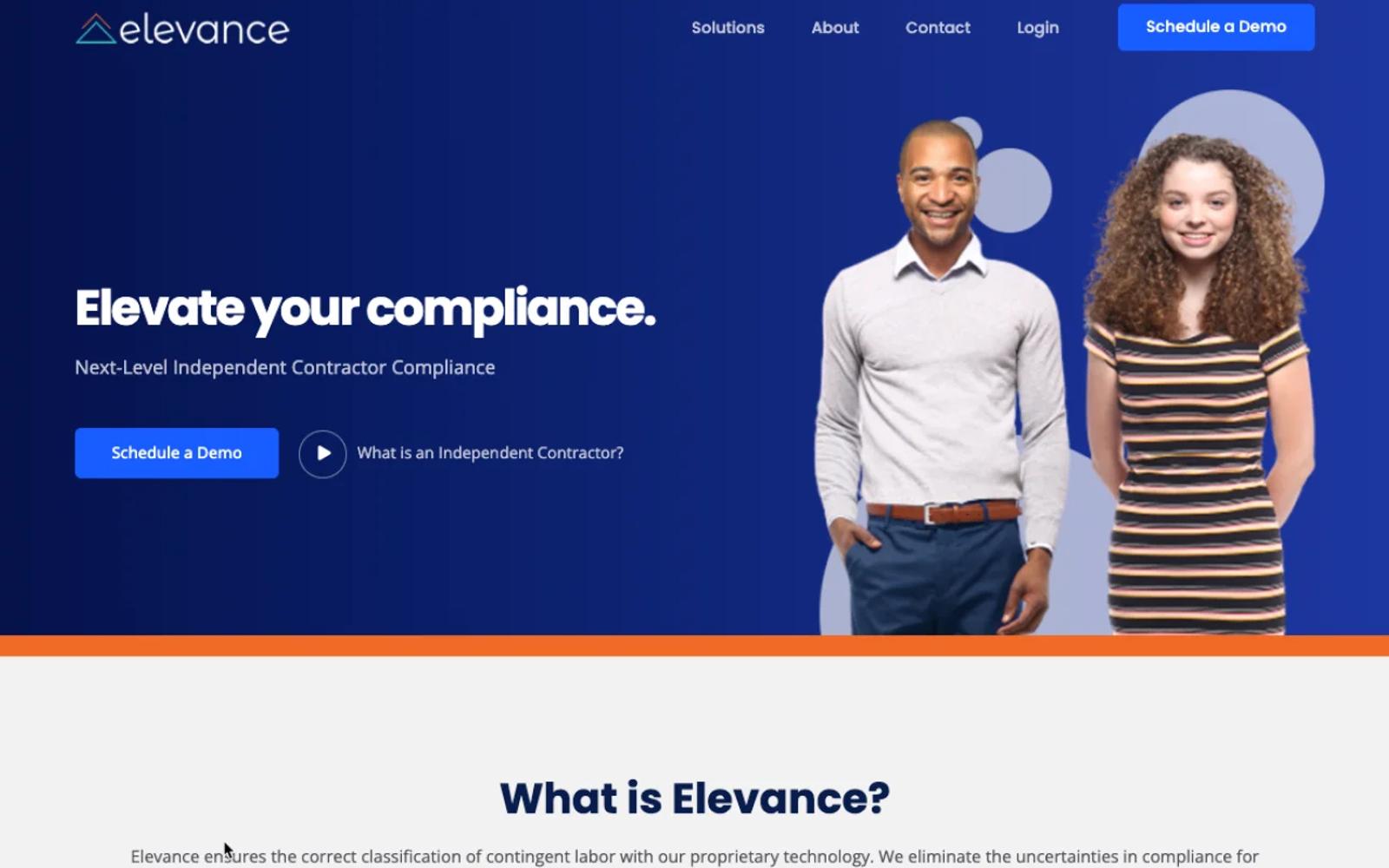
Custom Compliance Platform Transforms Risky Manual Worker Classification Into Audit-Ready Automated Assessment System
Project Overview
Elevance represents enterprise-scale workforce management complexity—as major health benefits company managing thousands of workers across federal, state, and local jurisdictions, the organization faces critical compliance challenge determining proper worker classification for each individual: employee vs. independent contractor, exempt vs. non-exempt status, benefit eligibility determinations, tax withholding requirements, and labor law compliance across 50 states plus international jurisdictions. This classification responsibility carries enormous legal and financial risk: IRS penalties for misclassification, Department of Labor violations, state-specific labor law enforcement, back taxes and benefits owed, class action lawsuit exposure, and reputational damage from compliance failures.
Their operational challenge combined legal complexity with process scale—worker classification decisions require evaluating dozens of factors across multiple legal tests (IRS Common Law Test, Economic Reality Test, ABC Test varying by state), applying jurisdiction-specific regulations constantly evolving through legislation and case law, coordinating decisions across HR, legal, compliance, and business stakeholders, and documenting rationale defensibly for potential audits or litigation. This sophisticated assessment previously relied on manual review: HR staff evaluating workers against inconsistent criteria, legal team consulting on complex cases creating bottlenecks, compliance department lacking systematic oversight, and classification decisions made through email discussions without centralized documentation or audit trail.
When Elevance leadership recognized this manual approach exposed unacceptable compliance risk while constraining operational scalability, they engaged Code Conspirators to engineer automated solution—custom web application systematizing worker classification assessment, providing consistent evaluation across all jurisdictions, generating defensible audit documentation, and enabling collaborative decision-making among HR, legal, and compliance stakeholders. This strategic initiative aimed transforming risky manual process into reliable compliance engine supporting workforce expansion while protecting against regulatory and legal exposure.
The Strategic Challenge
Multi-Jurisdictional Compliance Complexity:
50+ State Variations Plus Federal Standards:
Worker classification governed by overlapping legal frameworks:
Federal Standards:
IRS Classification (Tax Purposes):
Common Law Test evaluating 20 factors across three categories:
- Behavioral Control: Who controls how work is performed?
- Financial Control: Who controls business aspects of work?
- Relationship Type: How parties perceive their relationship?
Department of Labor (FLSA Compliance):
Economic Reality Test determining:
- Employee vs. independent contractor
- Exempt vs. non-exempt status
- Overtime eligibility
- Minimum wage applicability
State-Specific Tests:
ABC Test (Massachusetts, California, New Jersey, others):
Worker presumed employee unless:
- (A) Free from control in performance
- (B) Performs work outside usual course of business
- (C) Customarily engaged in independent trade/occupation
Varying State Standards:
- Some states follow federal guidelines
- Others apply stricter ABC test variations
- Hybrid approaches combining multiple tests
- Regular legislative changes updating requirements
Local Ordinances:
- City-specific minimum wage laws
- Local benefit requirements
- Municipal contractor regulations
Complexity Example:
Software developer working remotely for Elevance from California:
Must evaluate against:
- Federal IRS standards (tax withholding)
- Federal DOL standards (FLSA overtime)
- California ABC test (stricter than federal)
- California-specific exemptions and carve-outs
- Any local San Francisco/Los Angeles ordinances
Factors Evaluated:
Sample questions requiring assessment:
- Does Elevance control work schedule?
- Who provides equipment and software?
- Can worker serve other clients simultaneously?
- Is work performed central to Elevance business?
- What training does Elevance provide?
- How is worker compensated (hourly, salary, project)?
- Does relationship appear temporary or ongoing?
- Are benefits provided?
- Can worker be terminated at will?
- Does contract specify independent contractor status?
Each factor weighted differently across jurisdictions—systematic evaluation requiring legal expertise and consistent application.
Inconsistent Manual Classification Process:
Human Judgment Variability Creating Risk:
Pre-automation workflow:
Step 1: Classification Request
Business unit needs to engage worker (new hire, contractor, consultant)
Step 2: HR Initial Review
HR generalist reviews job description and relationship:
- Applies personal understanding of rules
- Inconsistent interpretation of factors
- Time-consuming research for unclear situations
- Different HR staff reaching different conclusions for similar situations
Step 3: Escalation (When Uncertain)
Complex cases escalated to legal:
- Email threads explaining situation
- Attachments with contracts and descriptions
- Back-and-forth questions clarifying details
- Legal research required for jurisdiction-specific rules
- Bottleneck: Limited legal resources, many classification requests
Step 4: Compliance Review
Compliance department involvement sporadic:
- Sometimes consulted, sometimes not
- No systematic oversight of classifications
- Reactive rather than proactive engagement
- Audit concerns identified too late
Step 5: Decision and Documentation
Classification decision made:
- Communicated via email
- Rationale not systematically documented
- No centralized record of decision factors
- Inconsistent file retention
Problems:
Inconsistency:
Same role classified differently across business units, geographies, and time periods based on which HR person evaluated.
Risk Exposure:
Misclassifications discovered during audits or lawsuits:
- No defensible record of decision process
- Unable to demonstrate good-faith compliance effort
- Email discussions insufficient for legal defense
Scalability Constraint:
Manual review requiring hours per worker:
- Legal bottleneck limiting business growth
- Rush classifications increasing error likelihood
- Backlog of pending decisions delaying hiring
Knowledge Gaps:
HR staff not maintaining expertise across 50+ jurisdictions:
- States changing laws regularly
- Federal guidance evolving through regulatory updates
- Precedent-setting court cases impacting standards
Audit Trail and Documentation Deficiency:
Legal Defense Requiring Systematic Records:
Regulatory audits and misclassification lawsuits require demonstrating:
Good Faith Compliance Effort:
- Systematic evaluation process followed
- Relevant factors considered
- Jurisdiction-specific rules applied
- Expert input obtained where appropriate
- Documentation contemporaneous with decision
Defensible Rationale:
- Clear explanation of classification decision
- Specific factors supporting conclusion
- References to applicable legal standards
- Acknowledgment of ambiguous factors
Previous email-based process inadequate:
Scattered Documentation:
- Decision discussions across multiple email threads
- Attachments lost or difficult to locate
- No standard documentation format
- Inconsistent record retention
Incomplete Records:
- Rationale not always documented
- Factors not systematically evaluated
- Jurisdiction identification absent
- Timeline of decision unclear
Inaccessible Archives:
- Years-old emails difficult to retrieve
- Employees departed (mailboxes deleted)
- No centralized repository
- Search functionality inadequate
Audit Scenario:
IRS or DOL auditor requests:
"Show me how you determined this worker was independent contractor."
Desired response:
"Here's systematic assessment showing 15 factors evaluated against IRS test, weighted appropriately, with legal input documented, and clear rationale."
Previous reality:
"Let me search old emails... I think Sarah handled this... she's no longer with company... not sure where those emails are..."
Audit risk: Penalty presumption without defensible records demonstrating good-faith compliance.
Collaborative Decision-Making Challenge:
Stakeholder Coordination Across Departments:
Proper classification requires input from multiple functions:
HR Perspective:
- Practical workforce management considerations
- Hiring timeline and onboarding logistics
- Benefit administration implications
- Performance management approach
- Termination procedures
Legal Perspective:
- Regulatory compliance assessment
- Risk evaluation and mitigation
- Contract language requirements
- Litigation defense considerations
- Multi-jurisdiction complexities
Compliance Perspective:
- Audit readiness requirements
- Policy adherence verification
- Systematic oversight maintenance
- Emerging risk identification
- Reporting to leadership and board
Business Unit Perspective:
- Operational needs and constraints
- Budget and cost implications
- Competitive hiring considerations
- Flexibility requirements
Previous process coordination:
Sequential Reviews:
HR → Legal → Compliance (if involved)
- Each step adding days or weeks
- Information requests repeated
- Context lost in handoffs
- Decisions made without full stakeholder input
Incomplete Information:
Each stakeholder seeing partial picture:
- Legal evaluating without operational context
- HR deciding without compliance perspective
- Decisions made in silos
Desired State:
Collaborative platform enabling:
- All stakeholders viewing same information simultaneously
- Shared assessment tool providing structure
- Comments and discussion captured in context
- Decision reached with full input
- Record preserving collaborative process
Scalability for Global Workforce:
US Pilot Requiring International Expansion:
Initial focus: US-based workers across 50 states
Future requirement: Global workforce expansion
International Complexity:
- European Union regulations (varying by member state)
- UK employment law post-Brexit
- Canadian provincial variations
- Latin American labor codes
- Asia-Pacific regulatory diversity
- Tax treaty implications
- Permanent establishment risk
Platform architecture needed supporting:
- New jurisdiction addition without code rewrite
- Country-specific assessment criteria
- Multi-language support
- Currency and benefit variations
- Local compliance team access
Code Conspirators' Strategic Solution
Intelligent Assessment Engine:
Automated Factor Evaluation with Pass/Fail Scoring:
Custom web application architecture:
Assessment Question Bank:
Jurisdiction-mapped evaluation criteria:
Federal IRS Test Questions:
- "Does the company control how the worker performs their job duties?"
- "Who provides the tools, equipment, and supplies?"
- "Does the worker have unreimbursed business expenses?"
- "Can the worker realize profit or loss from their activities?"
- "Does the worker make services available to the general market?"
- "How is the worker compensated?" (hourly, salary, commission, project)
- "Does the worker receive employee-type benefits?"
- "Can the relationship be terminated by either party at will?"
Each question linked to relevant factors in IRS 20-factor test.
State-Specific Questions:
California ABC Test assessment:
- "Is the worker free from the company's control and direction?"
- "Does the worker perform work outside the usual course of company's business?"
- "Is the worker customarily engaged in an independently established trade?"
Questions adapt based on worker location—California worker sees ABC test, Texas worker sees economic reality test.
Weighted Scoring Algorithm:
Backend logic evaluating responses:
javascript
// Simplified scoring logic
function calculateClassificationScore(responses, jurisdiction) {
let score = 0;
let factors = getFactorsForJurisdiction(jurisdiction);
factors.forEach(factor => {
let response = responses[factor.question_id];
let weight = factor.weight;
let points = evaluateResponse(response, factor.criteria);
score += (points * weight);
});
// Score interpretation
if (score >= jurisdiction.employee_threshold) {
return {
classification: 'EMPLOYEE',
confidence: calculateConfidence(score),
rationale: generateRationale(responses, factors)
};
} else if (score >= jurisdiction.contractor_threshold) {
return {
classification: 'INDEPENDENT_CONTRACTOR',
confidence: calculateConfidence(score),
rationale: generateRationale(responses, factors)
};
} else {
return {
classification: 'AMBIGUOUS',
recommendation: 'LEGAL_REVIEW_REQUIRED',
areas_of_concern: identifyAmbiguities(responses, factors)
};
}
}
Pass/Fail Determination:
Clear classification outcome:
- PASS (Employee): Worker clearly meets employee criteria
- PASS (Independent Contractor): Worker clearly meets IC criteria
- FAIL (Ambiguous): Mixed factors requiring legal review
Multi-Jurisdiction Evaluation:
If worker operates across states:
- Assessment runs for each applicable jurisdiction
- Most restrictive classification recommended
- Conflicts identified and flagged
- Rationale explains multi-state considerations
Resolution Guidance System:
Actionable Recommendations for Ambiguous Cases:
When classification unclear:
Issue Identification:
System highlights problematic factors:
"⚠️ Potential Misclassification Risk:
- Worker reports directly to Elevance manager (Employee indicator)
- Worker uses own equipment and sets schedule (IC indicator)
- Work is core to Elevance business operations (Employee indicator, especially in California)
Recommendation: These mixed factors create classification ambiguity. Consider:"
Restructuring Options:
Specific suggestions improving classification clarity:
Option 1: Strengthen Independent Contractor Status
- Modify contract to emphasize project-based deliverables
- Remove schedule requirements allowing full flexibility
- Eliminate direct reporting relationship
- Document worker's other clients
- Revise payment terms to project basis rather than hourly
Option 2: Reclassify as Employee
- Convert to W-2 employee status
- Provide benefits per standard policy
- Ensure FLSA exempt vs. non-exempt determination
- Include in performance management processes
- Apply employee handbook policies
Risk Assessment:
Each option presented with risk evaluation:
Independent Contractor Path:
- Risk Level: MEDIUM-HIGH (in California)
- Audit Exposure: If misclassified, $X estimated penalty
- Litigation Risk: Worker could claim employee benefits retroactively
- Mitigation: Requires contract restructuring and operational changes
Employee Path:
- Risk Level: LOW
- Compliance: Full regulatory compliance achieved
- Cost Impact: Benefits and payroll tax addition estimated at $X,XXX annually
- Operational: Standard employee management applies
Legal Review Trigger:
High-risk scenarios automatically escalating:
- Ambiguous classification in litigious jurisdiction (CA, MA, NJ)
- High-value worker (significant penalty exposure)
- Large cohort of similarly situated workers (class action risk)
- Previous misclassification history in that role
Legal team receives:
- Assessment summary with scores
- Flagged risk factors
- Recommended review areas
- Business context and urgency
Audit-Ready Documentation Trail:
Defensible Compliance Records:
Every assessment creating comprehensive record:
Assessment Record Contents:
Basic Information:
- Worker name and identifier
- Position/role description
- Business unit and manager
- Jurisdiction(s)
- Assessment date
- Assessed by (HR user)
Question Responses:
Complete record of all answers:
- Each question and selected response
- Free-text explanations or notes
- Supporting documentation uploaded (contracts, SOWs)
- Timestamp of responses
Scoring Details:
- Raw score calculation
- Factor weights applied
- Jurisdiction-specific thresholds
- Classification determination
- Confidence level
Rationale Generation:
Auto-generated explanation:
"Based on evaluation of IRS Common Law Test factors for Texas jurisdiction:
Employee Indicators (60 points):
- Behavioral control: Worker follows company policies and procedures
- Training provided: Elevance provides role-specific training
- Full-time relationship: Worker dedicated full-time to Elevance
- Core business activity: Work is central to Elevance operations
Independent Contractor Indicators (25 points):
- Financial investment: Worker provides own computer equipment
- Method of payment: Paid by project milestone
Conclusion: Preponderance of factors indicate EMPLOYEE classification appropriate. Recommend W-2 treatment with appropriate benefits and withholding."
Stakeholder Review Trail:
Comments and approvals tracked:
- HR review: "Assessment complete, recommend employee classification"
- Legal review: "Concur with employee determination given control factors"
- Compliance sign-off: "Approved for proceeding"
- Timestamp and user for each entry
Version Control:
Assessment changes tracked:
- Original responses preserved
- Modifications documented with reason
- User making changes identified
- Audit trail of decision evolution
Export Capabilities:
PDF report generation:
- Professional formatted assessment
- Complete question/answer record
- Classification determination with rationale
- Stakeholder approvals
- Suitable for audit presentation or litigation
Centralized Repository:
Database storing all assessments:
- Searchable by worker, role, jurisdiction, date
- Filterable by classification outcome
- Reportable for compliance dashboards
- Accessible to authorized users (RBAC)
- Backed up and archived per retention policy
Audit Response:
When auditor requests classification documentation:
- Search system by worker or timeframe
- Pull complete assessment record
- Generate PDF report
- Demonstrate systematic evaluation process
- Show contemporaneous documentation
- Provide stakeholder review evidence
Audit defense strengthened: "We utilize systematic classification assessment platform evaluating all relevant factors, documenting rationale, and maintaining audit trail—demonstrating good-faith compliance effort and reasonable reliance on structured methodology."
Collaborative Workflow Platform:
Shared Decision-Making Across HR, Legal, Compliance:
Multi-user access with role-based permissions:
HR User Role:
- Initiate new assessments
- Complete question responses
- Upload supporting documentation
- View classification recommendations
- Submit for review
- Track pending assessments
Legal User Role:
- View submitted assessments
- Add legal analysis and comments
- Override classification if necessary with rationale
- Flag high-risk scenarios
- Approve or request modifications
- Access historical precedents
Compliance User Role:
- Dashboard view of all classifications
- Risk reporting and analytics
- Audit trail access
- Policy compliance verification
- Board reporting data extraction
- Trend identification
Business Unit User Role (Limited):
- View status of their worker assessments
- Provide operational context via comments
- Understand classification implications
- Access educational resources
Workflow States:
Assessment lifecycle:
- DRAFT: HR completing questions
- SUBMITTED: Ready for review
- LEGAL REVIEW: Legal team evaluating
- COMPLIANCE REVIEW: Compliance verification
- APPROVED: Classification finalized
- IMPLEMENTED: Worker properly classified in HR system
- ARCHIVED: Assessment completed and documented
Notification System:
Email alerts for workflow progression:
- HR notified when legal review complete
- Legal receives alert for new submissions requiring review
- Compliance updated on high-risk classifications
- Business unit informed of final determination
Dashboard Analytics:
Real-time visibility:
HR Dashboard:
- Pending assessments count
- Average time to completion
- Recent submissions status
- Training resources
Legal Dashboard:
- Reviews requiring attention
- High-risk scenarios flagged
- Response time metrics
- Jurisdiction breakdown
Compliance Dashboard:
- Total assessments completed
- Classification distribution (employee vs. IC %)
- Risk scoring across workforce
- Audit readiness indicators
- Trend analysis (increasing IC usage, etc.)
Collaborative Comments:
Threaded discussion within assessment:
HR: "This worker provides specialized expertise we don't have in-house. Recommending IC."
Legal: "Agreed on expertise, but note worker will be on-site daily and reporting to departmental manager. This creates behavioral control indicators. Recommend employee classification or restructure relationship."
HR: "Understood. Will discuss with business unit. Can we modify to remote work with deliverable-based oversight?"
Legal: "That would strengthen IC classification. Document in contract that worker determines methods and means, we only specify deliverables and deadlines."
All discussion preserved in assessment record—demonstrating collaborative analysis and good-faith compliance effort.
WordPress-Based Platform Architecture
Custom Application Development:
Enterprise-Grade Compliance Tool:
WordPress as application framework:
Why WordPress:
- Familiar CMS for Elevance IT team
- Robust user management and authentication
- Established security practices
- Plugin extensibility for custom features
- Scalable hosting options
- Lower total cost of ownership vs. custom application
Custom Plugin Development:
"Elevance Worker Classification" Plugin:
Features:
- Assessment question bank management
- Jurisdiction mapping and rules engine
- Scoring algorithm implementation
- Workflow state management
- User roles and permissions
- Reporting and analytics
- PDF export functionality
- Email notification system
Database Schema:
Custom tables storing:
Classifications Table:
- classification_id (primary key)
- worker_identifier
- position_title
- jurisdiction
- assessment_date
- assessed_by_user_id
- classification_result
- confidence_score
- status (draft, submitted, approved, etc.)
Responses Table:
- response_id
- classification_id (foreign key)
- question_id
- response_value
- response_notes
- timestamp
Questions Table:
- question_id
- question_text
- factor_category
- jurisdictions_applicable
- weight_by_jurisdiction (JSON)
- response_options
Comments Table:
- comment_id
- classification_id
- user_id
- comment_text
- timestamp
Audit_Log Table:
- log_id
- classification_id
- action_type (created, modified, submitted, approved)
- user_id
- timestamp
- changes_made (JSON)
Security and Compliance:
Enterprise Data Protection:
Access Control:
- Role-based access control (RBAC)
- Single sign-on (SSO) integration with Elevance AD
- Multi-factor authentication required
- Session timeout policies
- IP restriction options
Data Encryption:
- SSL/TLS for data in transit
- Database encryption at rest
- Sensitive field encryption (worker identifiers)
- Secure file upload handling
Audit Logging:
- All user actions logged
- Login/logout tracking
- Data access monitoring
- Change history preservation
- Suspicious activity alerting
Compliance Standards:
- SOC 2 Type II controls consideration
- GDPR privacy provisions (for future international)
- Data retention policies
- Right to deletion procedures
- Backup and disaster recovery
Integration Capabilities:
Enterprise System Connectivity:
HR System Integration:
Future-state capability for:
- Worker data import (names, roles, locations)
- Classification status export
- Automated synchronization
- Duplicate prevention
Payroll System Integration:
Classification outcome feeding:
- W-2 vs. 1099 determination
- Withholding requirements
- Benefit eligibility
- Tax jurisdiction codes
Reporting and Analytics:
Data export to:
- Executive dashboards
- Compliance reporting
- Board presentations
- External audit requests
Measurable Business Impact
Compliance Risk Mitigation:
- Standardized classification process across all jurisdictions
- Audit-defensible documentation for every worker
- Legal review systematically applied to high-risk scenarios
- Consistent application of regulatory standards
- Reduced misclassification penalty exposure
Operational Efficiency:
- Assessment completion time reduced from days to hours
- Legal bottleneck eliminated for straightforward cases
- HR team empowered with structured tool
- Scalable process supporting workforce growth
- Automated documentation eliminating manual record-keeping
Decision Quality:
- Multi-factor evaluation preventing oversights
- Jurisdiction-specific rules consistently applied
- Collaborative stakeholder input captured
- Historical precedent accessible for similar situations
- Resolution guidance improving classification accuracy
Audit Readiness:
- Immediate production of assessment records
- Systematic process demonstration
- Good-faith compliance evidence
- Complete audit trail preservation
- Professional documentation suitable for legal defense
Scalability Achievement:
- US pilot successfully deployed across 50 states
- Platform architecture supporting global expansion
- New jurisdiction addition without system rebuild
- Growing workforce accommodated without additional headcount
- Foundation for international worker classification
Strategic Partnership Value
Enterprise Compliance Expertise:
Code Conspirators understood critical nature of regulatory compliance systems—architecting robust platform balancing user experience with audit requirements and legal defensibility.
Complex Business Logic:
Multi-jurisdictional classification rules requiring sophisticated scoring algorithms, jurisdiction mapping, and weighted factor evaluation—implementing business logic that legal and compliance teams trust.
Collaborative Workflow Design:
Recognition that proper classification requires multi-stakeholder input—designing platform enabling HR, legal, and compliance coordination while maintaining clear accountability and documentation.
Security and Audit Requirements:
Enterprise-grade system requiring data protection, access control, comprehensive logging, and long-term record retention for legal defense.
Ongoing Partnership:
Long-term relationship supporting:
- Platform maintenance and updates
- New jurisdiction additions as business expands
- Feature enhancements based on user feedback
- Regulatory update implementation
- Performance monitoring and optimization
- Security updates and penetration testing
- User training and documentation
- Analytics and reporting expansion
- International rollout support
Conclusion
The Elevance project demonstrates Code Conspirators' ability to engineer mission-critical compliance platforms solving complex regulatory challenges through intelligent automation and systematic documentation. By building custom WordPress-based worker classification assessment tool with multi-jurisdictional rules engine, pass/fail scoring, resolution guidance, audit-ready trail, and collaborative workflow, we helped Elevance transform risky manual classification process into reliable compliance engine protecting against regulatory penalties and litigation exposure.
This wasn't just custom development—it was compliance risk transformation through strategic automation. The intelligent assessment standardizes evaluation across jurisdictions, resolution guidance helps navigate ambiguity, audit documentation provides legal defensibility, collaborative workflow enables proper stakeholder coordination, and scalable architecture supports global workforce expansion.
For Elevance, this platform represents foundation for compliant workforce scaling, audit preparedness, and systematic risk management protecting against multi-million dollar penalty exposure. For HR, legal, and compliance teams, it provides structured tool enabling confident classification decisions with defensible documentation. And for Code Conspirators, it exemplifies our capability to architect enterprise compliance systems addressing sophisticated regulatory requirements—delivering intelligent automation, audit readiness, and measurable risk mitigation.
As Elevance continues growing their workforce across US markets with plans for global expansion, their worker classification platform continues ensuring regulatory compliance, documenting decisions defensibly, and enabling scalable growth—demonstrating that even complex legal compliance requirements can be systematized through thoughtful custom application development that respects both regulatory rigor and operational efficiency needs.
Key Takeaway: Enterprise workforce compliance requires systematic assessment tools that standardize evaluation, document decisions defensibly, and enable collaborative stakeholder input across jurisdictions. Code Conspirators engineers custom compliance platforms with intelligent automation, audit-ready documentation, and scalable architecture that transform manual risk into systematic regulatory confidence.